
 Video Libraries
Written by Taiyo! ITER Japan News
Hello, I’m Taiyo Tenno. I hope you enjoyed ITER Manga Vol.8 .
Thank you for your patience. I’m pleased to share the latest ITER Japan News article that I authored.
Click on the headline of the content you want to read to expand or collapse each article.
Interview by Taiyo!
The “Sun on Earth” Opening the Future of Energy
— The Fusion Challenge Shaped by JT-60SA and ITER —
What Is “Energy”?
— The Difference Between Fossil Fuels and Nuclear Fusion Energy
Recently, we often hear discussions about energy, with terms such as “a decarbonized society” and “renewable energy.”
But what kinds of energy are there in the first place?


Energy sources are broadly classified into “fossil energy” and “non-fossil energy.”
Nuclear fusion energy belongs to the category of non-fossil energy.
Fossil fuels such as oil, coal, and natural gas release chemical energy through combustion.
While they are convenient and highly reliable, they inevitably emit carbon dioxid(CO2), which contributes to global warming.
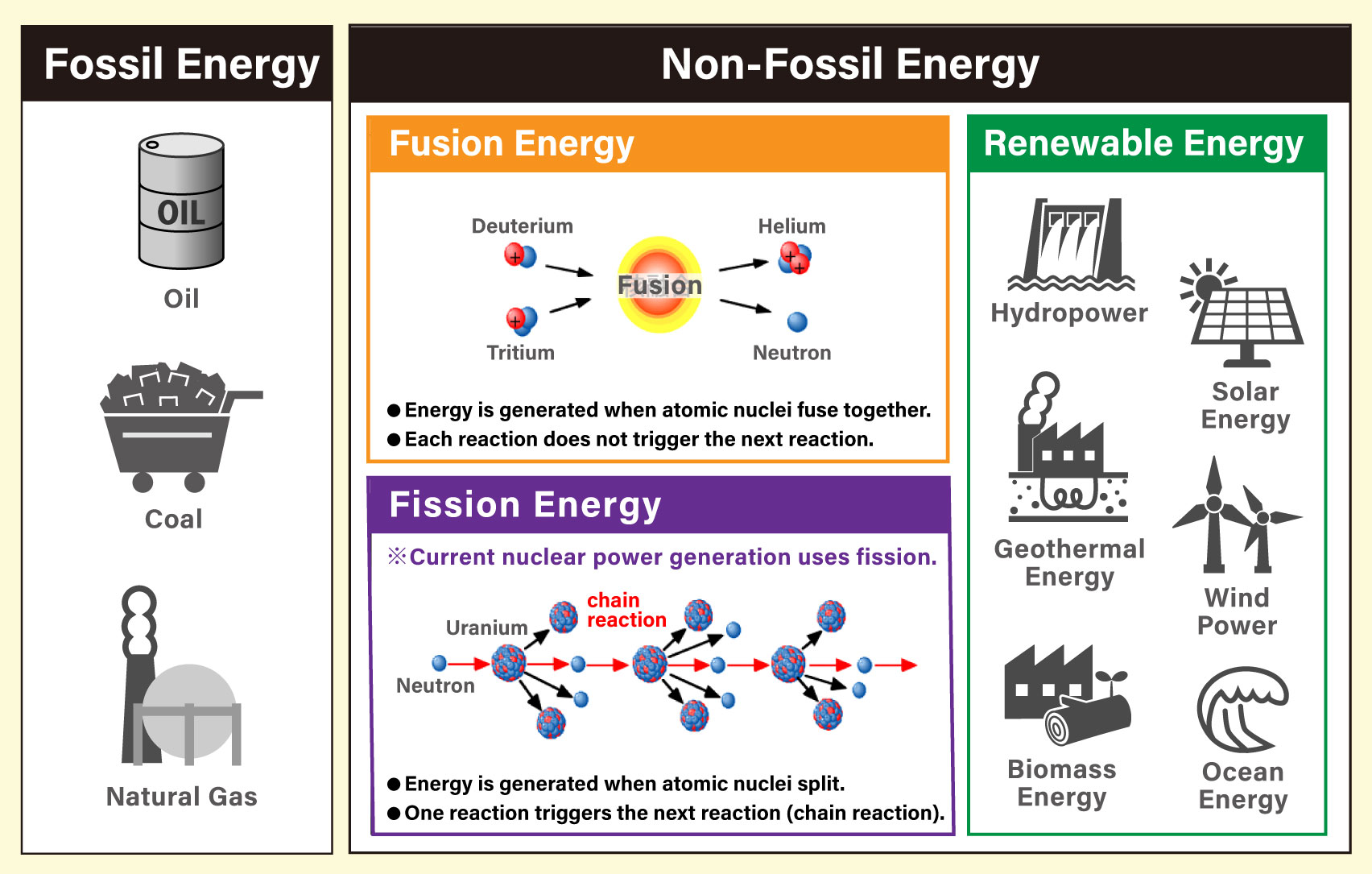
Diagram of fossil energy and non-fossil energy.
Nuclear fusion energy belongs to non-fossil energy.

As a result, achieving a decarbonized society has become an urgent global challenge.
The use of renewable energy is expanding, but its output can be unstable due to weather conditions.
Meanwhile, the restart of nuclear power plants is also being discussed, yet careful debate continues over safety and social acceptance.
Ultimately, the key question is how to balance “a stable energy supply” with “reducing environmental impact.”
This is one of the greatest challenges facing humanity.

This is wherenuclear fusion energycomes into focus!
By learning from the nuclear fusion reactions occurring inside the Sun, we are now working to realize fusion on Earth as a future energy source.
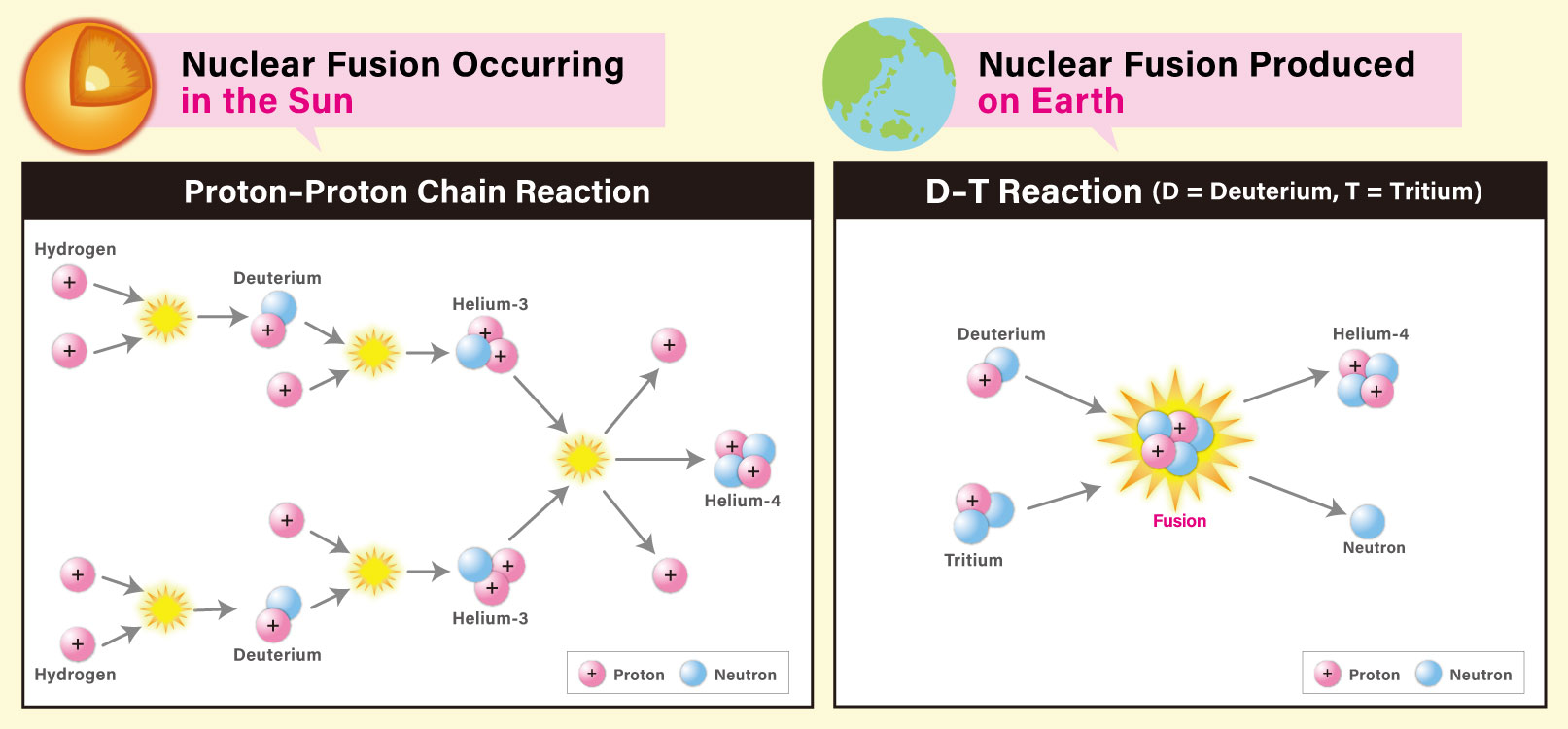
Nuclear fusion occurring in the Sun /
Nuclear fusion created on Earth
“Creating the Sun’s energy on Earth”
— now that is truly a dream worth pursuing!

The “Sun on Earth”
― The Overwhelming Potential of Nuclear Fusion

Nuclear fusion is a reaction in which light atomic nuclei—such as deuterium and tritium, both isotopes of hydrogen—fuse together to form helium.
In this process, a tiny amount of mass is lost and converted into an enormous amount of energy according to Einstein’s famous equation, E=mc2.
Just one gram of fuel can produce energy equivalent to eight tons of oil.

What’s more, this fuel can be extracted from seawater.
It is virtually inexhaustible, produces no CO2, poses no risk of runaway reactions, and generates only a very small amount of radioactive waste.
It is the ultimate sustainable energy source that humanity has long been seeking.
But if it’s so promising,
why hasn’t it been realized yet?

That’s because fusing atomic nuclei is extremely difficult.
To force positively charged nuclei to come together, their mutual electrostatic repulsion must be overcome, which requires temperatures of several hundred million degrees.
Matter in this state is called plasma, the fourth state of matter.
Plasma is neither solid, liquid, nor gas—it is a state in which electrically charged particles, ions and electrons, move freely.
The light from fluorescent lamps, auroras, and even the Sun itself are all examples of plasma.
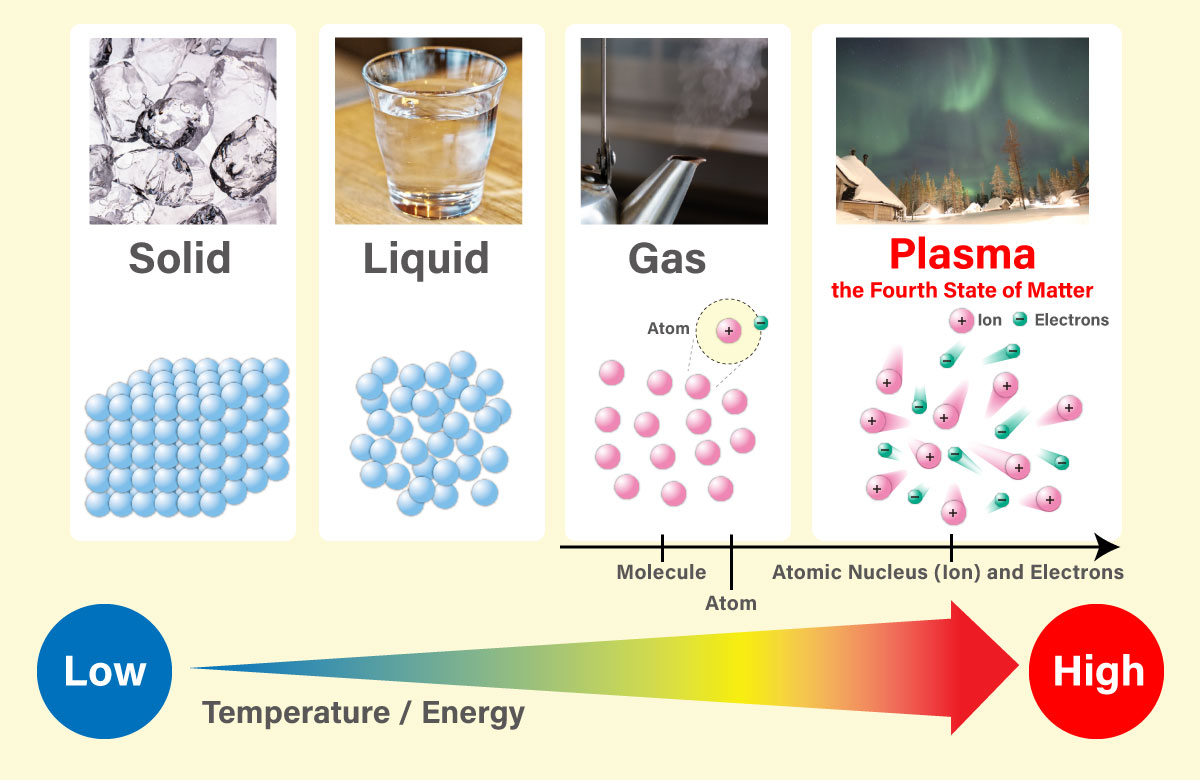
Plasma — the fourth state of matter
The challenge lies in how to stably confine this ultra-hot plasma without damaging it or allowing it to touch the surrounding container.
This is made possible by the magnetic confinement method.
By suspending plasma within donut-shaped magnetic field lines, it can be maintained without physical contact.
This is the approach adopted by JT-60SA and ITER.
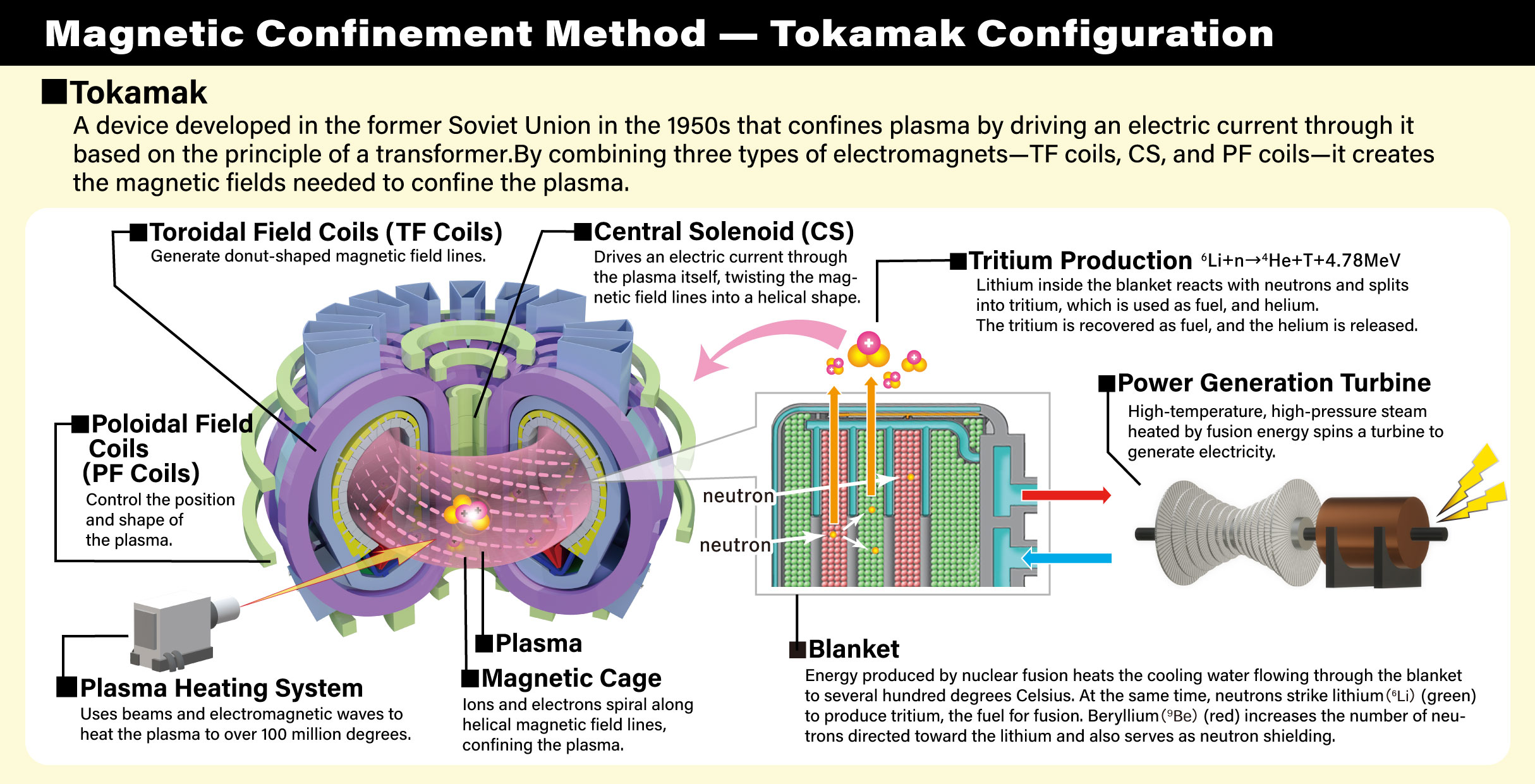
Magnetic Confinement Method — Tokamak Configuration
JT-60SA — Racing Toward the Future Together with ITER
So, the main players in fusion research are JT-60SA and ITER, right?

That’s right.
ITER, currently under construction in southern France, is an international experimental fusion reactor built through global collaboration.
Its goal is to actually produce fusion reactions and generate ten times more fusion energy than energy input.
And Japan’s JT-60SA is a facility that supports ITER.
It serves as a “satellite tokamak,” conducting complementary research that cannot be carried out at ITER and performing advanced verification of technical challenges before they are tested at ITER.
In other words, it is another engine driving ITER forward.
(Reference:What Is the JT-60SA Project?)
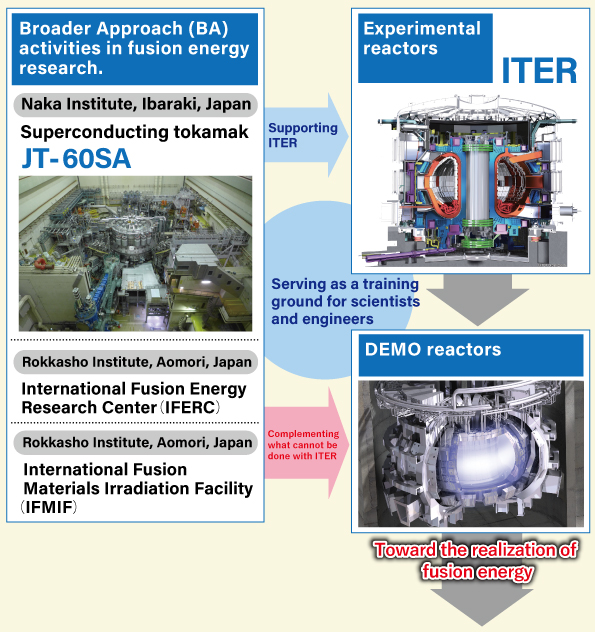
The roadmap toward realizing fusion energy
To put it another way—
JT-60SA is the front wheel of a bicycle, and ITER is the rear wheel.。
Working in balance, the two move together toward the goal of a future “DEMO reactor.”
Both are indispensable, and only when both wheels are in place can we truly move forward.
The front wheel opens the path, while the rear wheel drives the momentum
―― a perfect illustration of Japan and the world working together as they race toward the future!
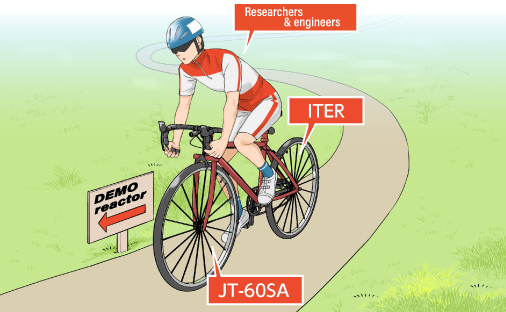
JT-60SA as the front wheel, ITER as the rear wheel
Testing Interrupted and Restarted
— Overcoming Technical Challenges
JT-60SA appears to be progressing smoothly, but I’ve heard that testing was once suspended. Is that true?
Yes, that’s right.
The device was completed in 2020, but in 2021, during integrated commissioning tests, damage to the insulation of a superconducting coil was discovered, and testing had to be suspended.
A detailed investigation revealed that part of the electrical insulation at a coil connection had been damaged.
Although repairs took about two years, we used that time to implement improvements that would lead to more stable operation. This included reinforcing insulation performance, developing new inspection methods to verify insulation integrity, and strengthening interlock systems that can instantly detect abnormalities and cut off the current.
Then, in 2023, after all improvements had been completed, integrated testing was resumed.
In October of that year, we finally achieved the first plasma!
Because we had overcome so many difficulties, that light felt especially beautiful.
The Moment of First Plasma
— The Day Miyazaki Set His Sights on the “Sun on Earth”
I’ve heard that your own decision to pursue this path was inspired by witnessing first plasma.
Yes.
When I was a student, I visited the Naka Institute and observed the moment of the first plasma.
After the countdown, a faint blue-violet light suddenly appeared on the pitch-black screen—and the instant I saw it, I felt chills and thought, “So this is the Sun on Earth…!”
I could never forget that moment, and it led me to pursue a career in plasma physics.
That truly was a light that changed your life.
JT-60SA First Plasma / First Plasma (October 23, 2023, 17:30)
Toward the Next Stage
— On the Road to Realizing Fusion Energy
JT-60SA is currently in the phase of performance enhancement upgrades.
(Reference: Latest JT-60SA Updates | Power-up Work )
To sustain hotter and denser plasma for longer periods, the heating systems and cooling systems are being reinforced.
Beyond this stage lie full-scale experiments involving actual fusion reactions.

Inside JT-60SA, extreme conditions—high temperature, ultra-high vacuum, strong magnetic fields, and cryogenic temperatures—coexist within a single device.
It truly deserves to be called a “miniature universe.”
Through this challenge, we are steadily accumulating knowledge that will lead to ITER and, ultimately, to future DEMO reactor.
In Closing — The “Sun on Earth” Has Already Begun to Shine
Fusion energy is more than just an energy source—it is a symbol of humanity’s wisdom and hope.
Yes.
The technology to control the ultimate form of energy is the ultimate crystallization of human knowledge.
JT-60SA and ITER—two wheels—continue racing toward the future.
We want to connect the blue-violet light we saw that day to the future of people all around the world.
That is the mission we researchers carry on.
Let’s Compare ITER and JT-60SA!
Differences Between ITER and JT-60SA
ITER is a full-scale experimental facility designed to demonstrate nuclear fusion power generation.
JT-60SA, on the other hand, is a research facility that prepares for and supports ITER.
JT-60SA operates high-performance plasma in the same tokamak configuration as ITER, reflecting its results back into the ITER project. It also plays a key role in training researchers and engineers who will lead ITER and future fusion research.
Because the success of ITER depends heavily on the achievements of JT-60SA, both facilities play crucial and complementary roles in realizing fusion power generation.
| Name | ITER |
|---|---|
| Full Name | ITER |
| Location | Saint-Paul-lez-Durance, France |
| Project Framework | Agreement on the Establishment of the ITER International Fusion Energy Organization for the Joint Implementation of the ITER Project (ITER Agreement) |
| Members | 7 Parties: EU, Japan, United States, Russia, China, Korea, India |
| Purpose | Experiments to achieve a fusion energy gain of Q = 10, required for fusion power generation |
| Role of Technology | Actually generate fusion energy and demonstrate the feasibility of power generation |
| Plasma Temperature | Approximately 150 million ℃ |
| Magnetic Confinement Method | Tokamak (using superconducting coils) |
| Fuel | Deuterium + Tritium (D–T fuel) |
| Fusion Gain (Q value) | Target: Q = 10 (10 times the input energy) |
| Start of Operation | Start of scientific research operation (SRO): 2034 |
| Device Size | Height: 30 m / Plasma radius: 6.2 m 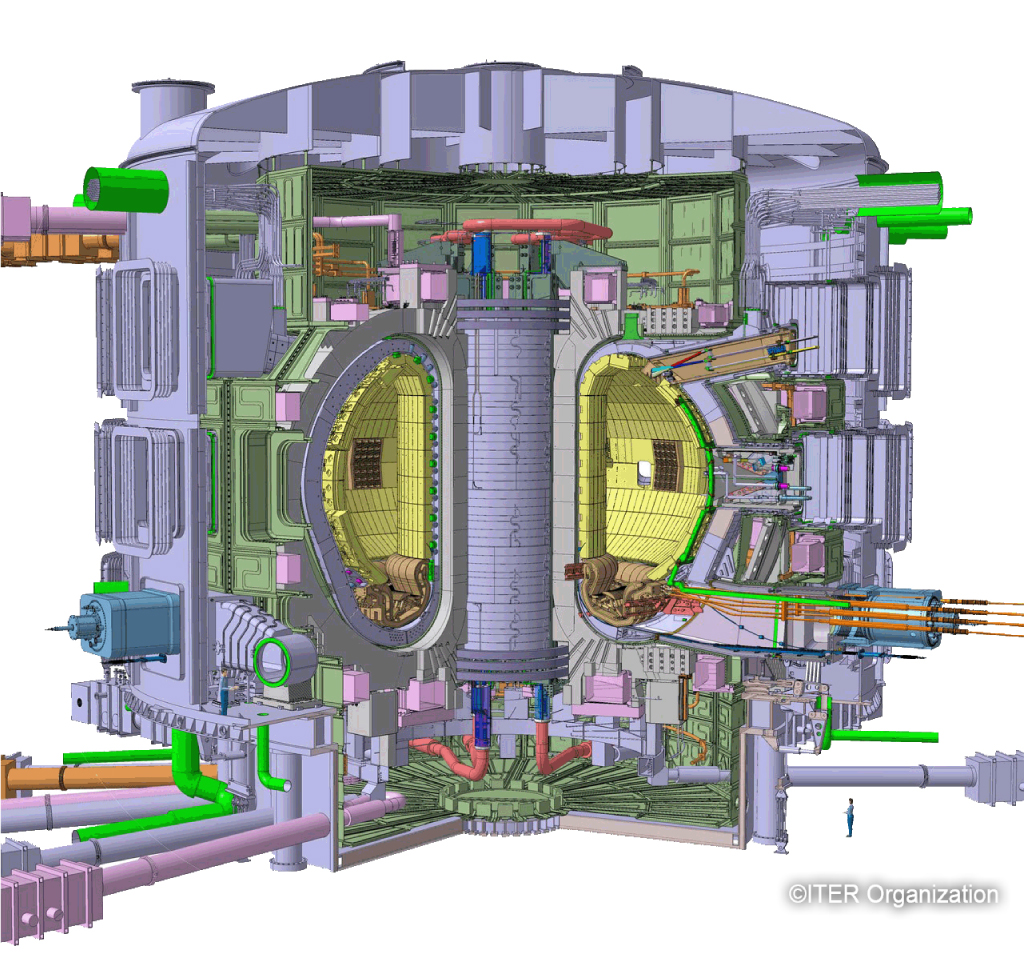 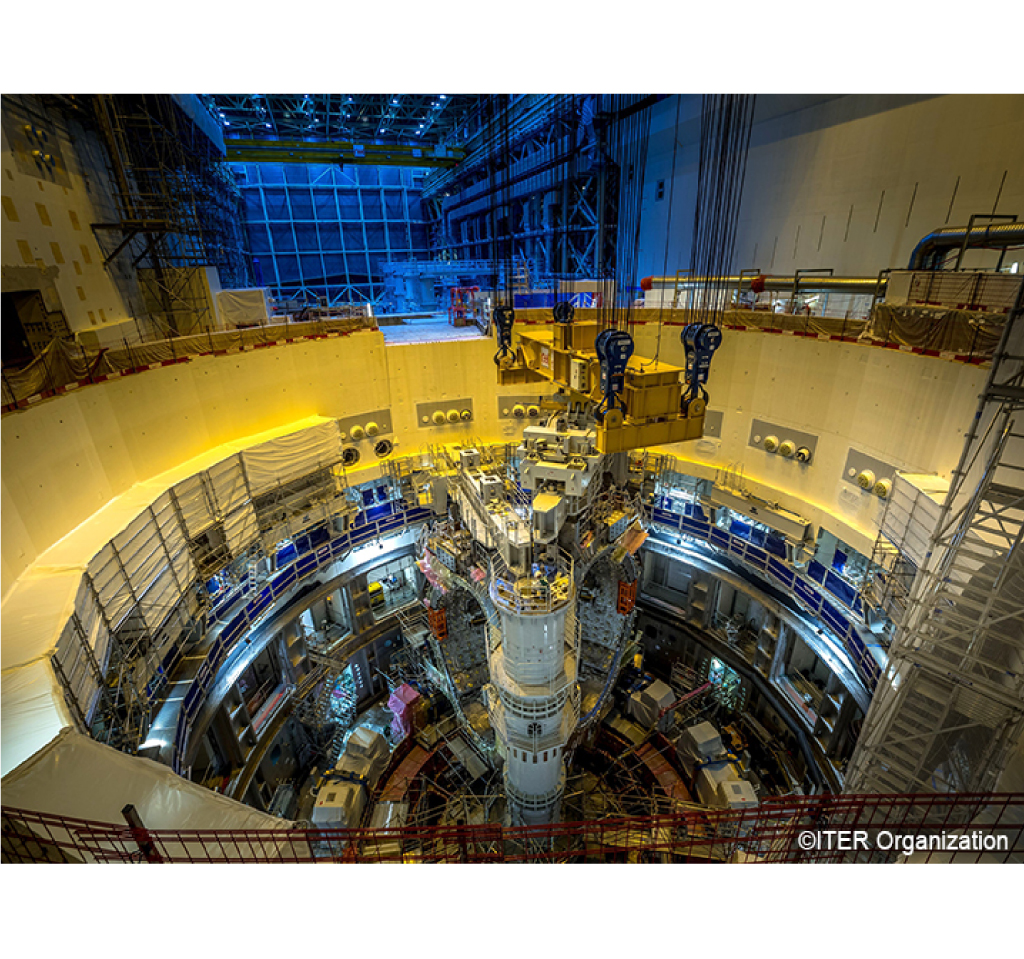 |
| Ultimate Goal | Decisive demonstration toward practical fusion energy (realization of burning plasma) |
| Official Website | ITER Organization https://www.iter.org/ ITER Japan Domestic Agency https://www.fusion.qst.go.jp/ITER/index.html |
| Name | JT-60SA |
|---|---|
| Full Name | JAERI Tokamak-60 Super Advanced |
| Location | Naka City, Ibaraki Prefecture, Japan |
| Project Framework | Joint project combining the Satellite Tokamak Program under the Broader Approach (BA) Activities between Japan and Europe and Japan’s national tokamak program |
| Members | Japan–EU collaboration |
| Purpose | Supporting ITER, leading toward DEMO reactor, and human resource development |
| Role of Technology | Research on technologies and plasma control required for ITER and future fusion reactors |
| Plasma Temperature | Approximately 100–200 million ℃ |
| Magnetic Confinement Method | Tokamak (using superconducting coils) |
| Fuel | Deuterium only (D–D fuel) |
| Fusion Gain (Q value) | Around Q ≈ 1 (when using actual fuel) |
| Start of Operation | 2023 (First plasma achieved) |
| Device Size | Height: 15m / Plasma radius: 3m 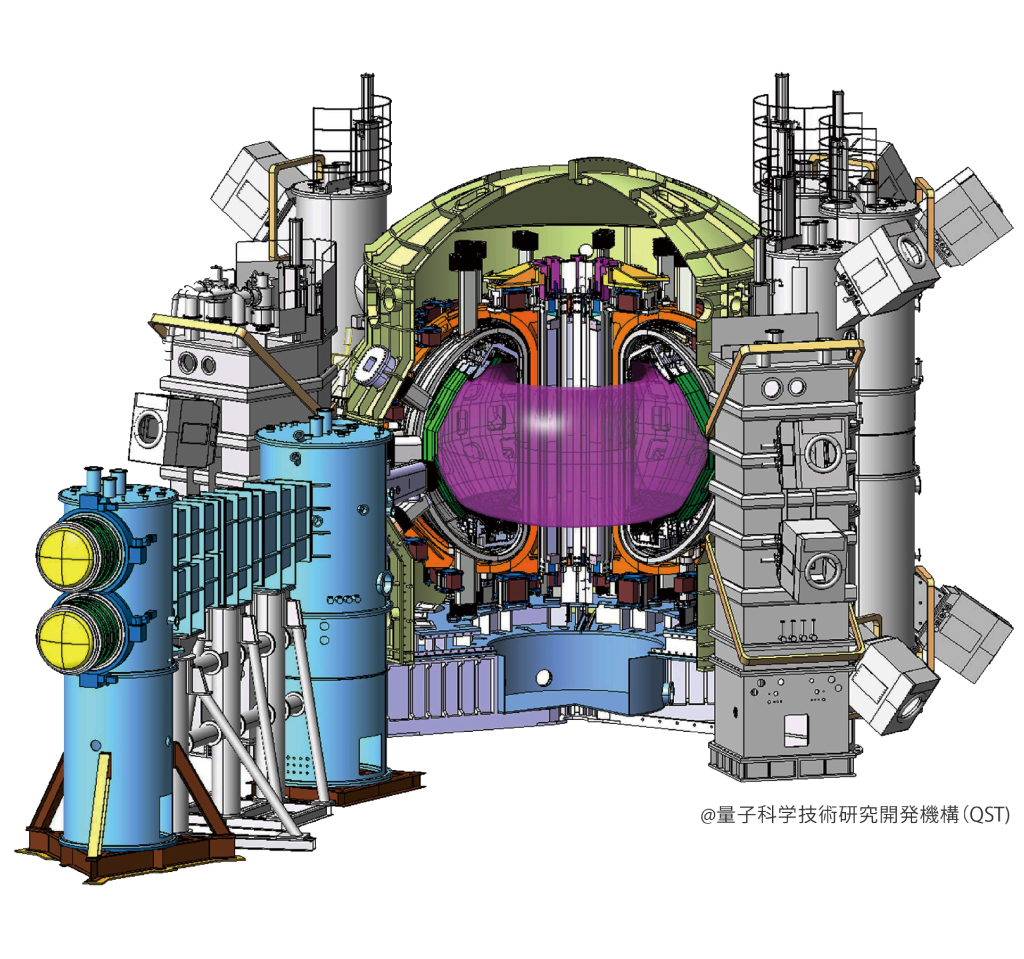 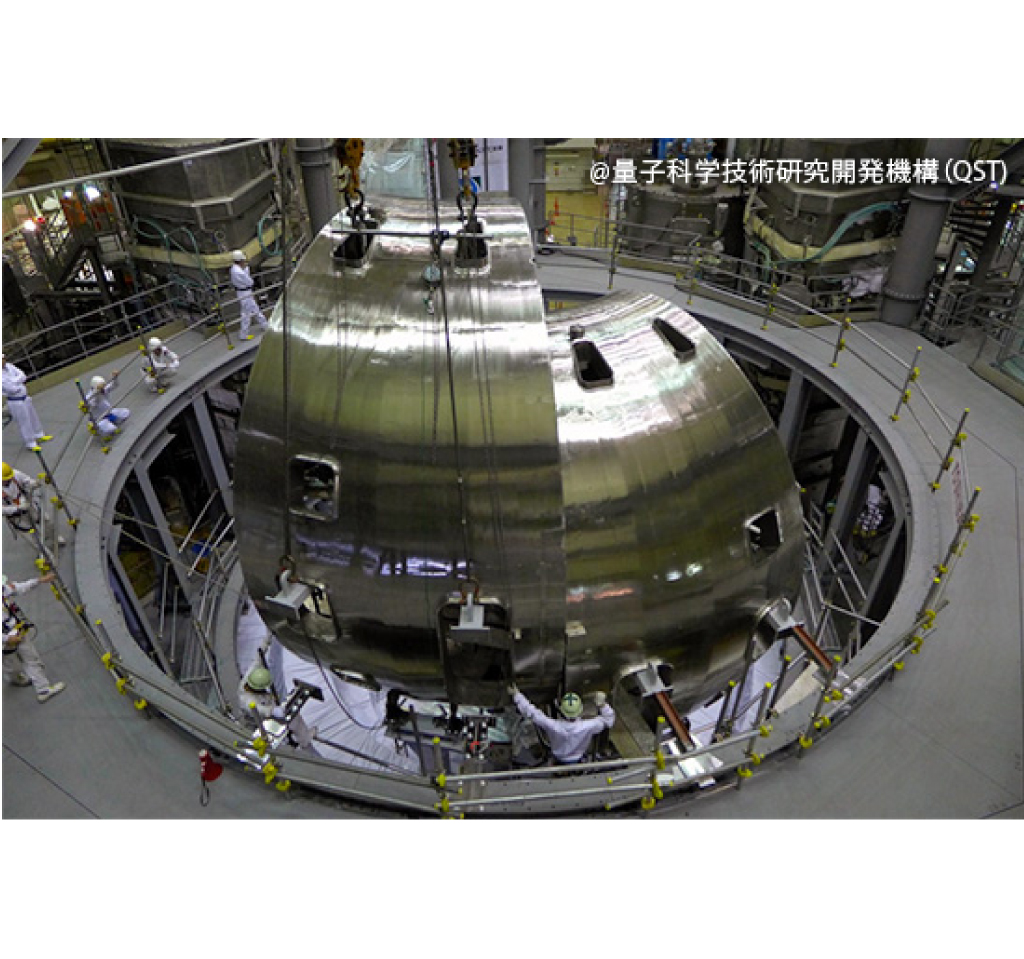 |
| Ultimate Goal | Support for ITER and development of technologies for future fusion reactors |
| Official Website | JT-60SA Advanced Plasma Research https://www.qst.go.jp/site/jt60/ JT-60SA(English) https://www.jt60sa.org/wp/ |
How Are QST, the Quantum Energy Research Field,
Naka Institute, and the ITER Japan Domestic Agency Connected?
About the National Institutes for Quantum Science and Technology (QST)
QST is a National Research and Development Agency established in 2016 through the integration of the fusion research and development divisions of the Japan Atomic Energy Agency (JAEA) and the National Institute of Radiological Sciences (NIRS).
It conducts a wide range of cutting-edge research in fields such as quantum science, radiation science, and fusion energy.(See: QST |History and Tradition )。
During its first mid-term phase (FY2016–FY2022), QST promoted research under the guiding principle of “Creating Harmonized Diversity.”
In the second phase, which began in FY2023, QST aims to further strengthen this foundation and generate outcomes that meet societal needs.
QST has seven research sites across Japan—Rokkasho, Sendai, Naka, Takasaki, Chiba, Kizu, and Harima.
Across these sites, seven research institutes, one center, and one hospital carry out specialized research and international projects.
Building on quantum science and technology platforms, QST advances innovative and original R&D mainly in four research fields:
Quantum Technology Innovation Research Area
Quantum Medical Science Area
Quantum Energy Science and Technology Area
Quantum Beam Science Research Area
QST brochures are available on the “QST | pamphlets”webpage.
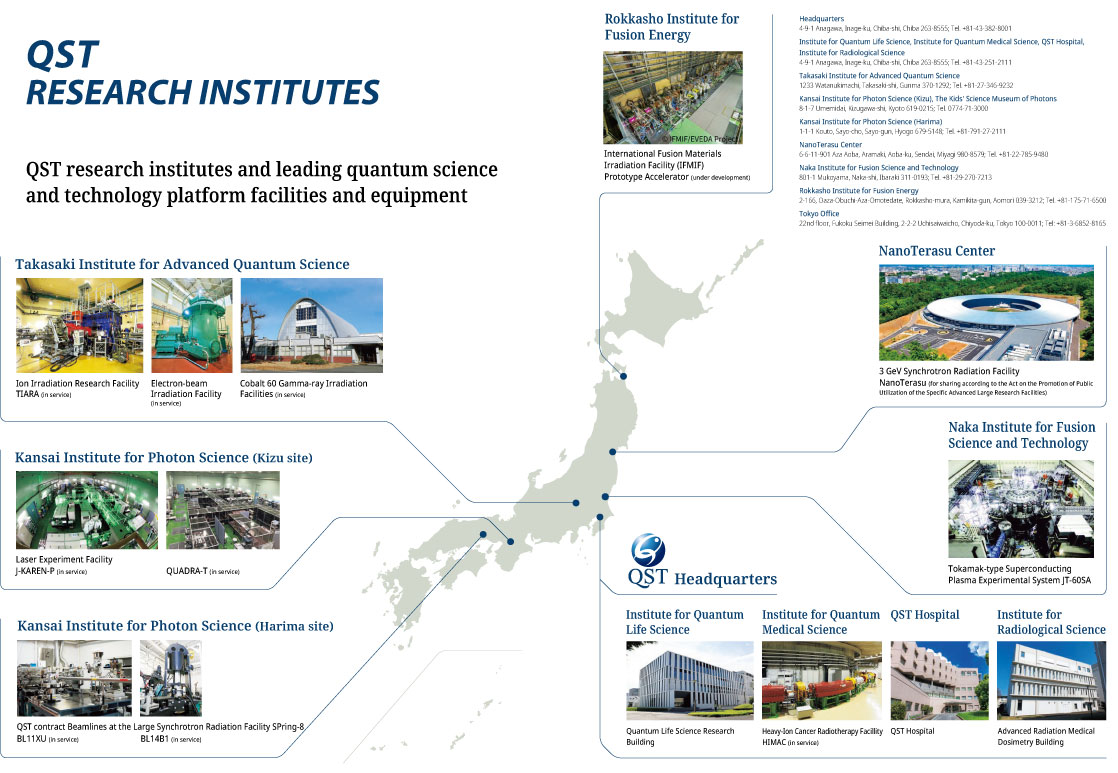
QST research institutes and major quantum science and technology platforms and facilities
(Date from: QST | Institutes )
About the Quantum Energy Research Field
QST consists of several research fields, and the one responsible for fusion energy research is Quantum Energy Science and Technology Area .
Both the Naka Institute for Fusion Science and Technology (Naka Institute) and Rokkasho Institute for Fusion Energy(Rokkasho Institute) belong to this field and conduct R&D aimed at realizing fusion power generation.
QST proposes a development roadmap toward a DEMO reactors that actually generates electricity,
consisting of three phases:
1. Power Generation Demonstration Phase– Demonstration of electricity generation using fusion reactions
2. Fuel Breeding Demonstration Phase– Verification of technologies for operation while producing fuel internally
3.Steady-State Operation Demonstration Phase– Demonstration of stable, long-duration operation
This plan fully leverages manufacturing technologies and operational knowledge developed through the international ITER project, achievements from Japan’s flagship experimental device JT-60SA, and the latest developments in equipment essential for power generation.
Centered around the Fusion Energy Promotion Strategy Office, which spans both the Naka and Rokkasho Institute, QST clarifies R&D directions while strengthening collaboration with industry.
Through initiatives such as J-Fusion and partnerships with private companies, the entire research field works as one to achieve the early realization of fusion energy.
Brochures on the Quantum Energy Research Field, Naka Institute, ITER, and JT-60SA are available at:
Reference: QST | Quantum Energy Research Field Brochure
About the Naka Institute for Fusion Science and Technology (Naka Institute)
The Naka Institute is one of Japan’s national research institutions, conducting research to reproduce nuclear fusion reactions occurring in the Sun on Earth and utilize them as an energy source.
Fusion energy produces no carbon dioxide, can be safely shut down when needed, and uses abundant fuel.
For these reasons, it is regarded as a promising future energy source and is positioned within Japan’s national strategy toward carbon neutrality by 2050.
Development of the Naka site began in 1979 in Naka City, Ibaraki Prefecture, and the institute was officially established in 1985 with the start of experiments.
Since then, it has achieved world-class results—such as ion temperatures of 520 million degrees Celsius and a fusion energy gain of 1.25—leading global fusion research.
Today, the Naka Institute participates in the international ITER project as Japan’s Domestic Agency, responsible for procuring major components.
This effort brings together the technologies of many Japanese companies.
The institute also advances the JT-60SA project, one of the Japan–EU Broader Approach (BA) activities At JT-60SA, experiments are conducted ahead of ITER, including changing plasma shapes and comparing performance, contributing to the development of future economical and high-performance fusion power plants.
Technologies developed through ITER and JT-60SA, combined with blanket system research at Rokkasho Institute, will form the foundation for constructing a future DEMO reactor to demonstrate power generation.
Working closely with Rokkasho Institute, the Naka Institute promotes ITER and BA activities and aims to serve as an international hub for fusion energy research.
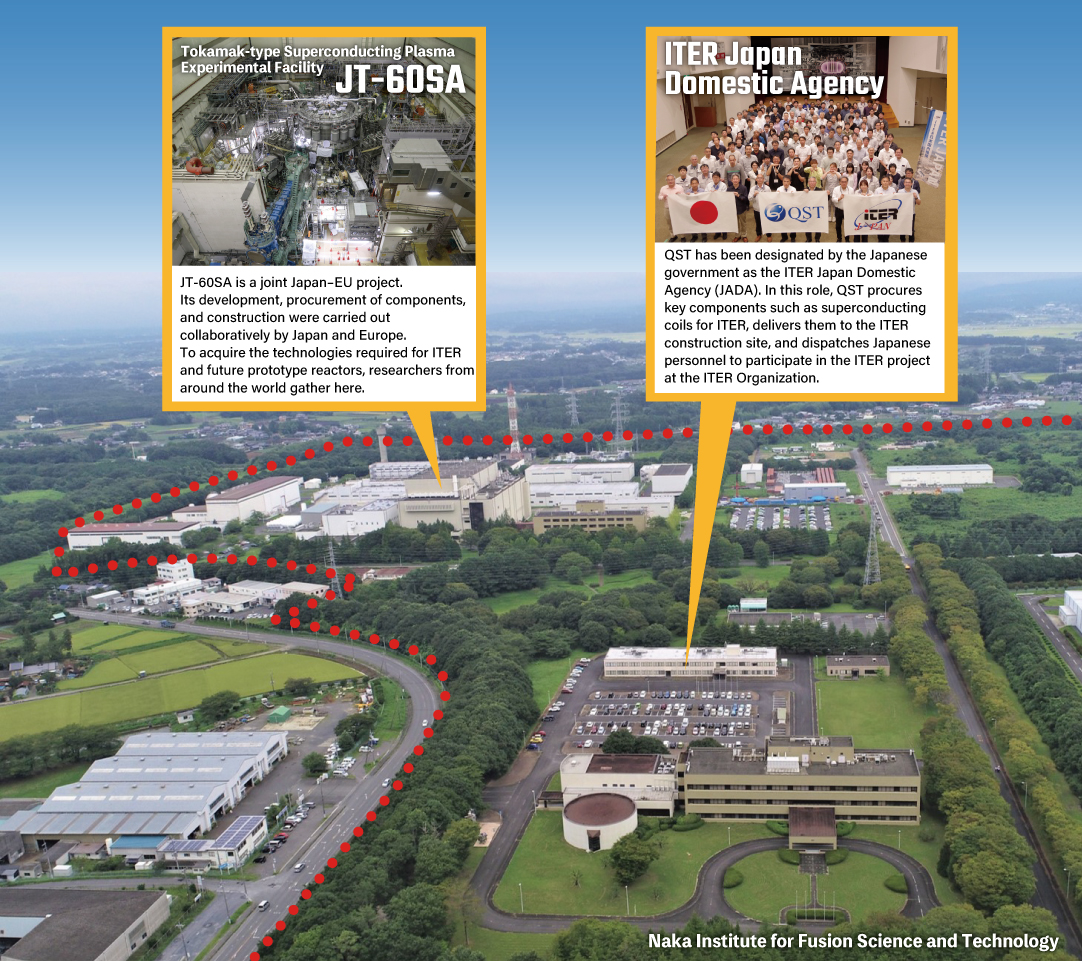
The area outlined in red is the Naka Institute.
The ITER Japan Domestic Agency and JT-60SA are located within the Naka Institute.
(Aerial photograph of the Naka Institute, taken September 2019)
About the ITER Japan Domestic Agency
Under the ITER project, each participating party establishes a domestic agency.
QST has been designated by the Japanese government as the ITER Japan Domestic Agency (JADA).
JADA is responsible for procuring components such as superconducting coils, delivering them to the ITER construction site, and dispatching personnel to participate in the project at the ITER Organization.
Reference: About the ITER Japan Domestic Agency
About the Broader Approach (BA) Activities
The Broader Approach (BA) activities are international R&D programs jointly promoted by Japan and the European Union to accelerate the early realization of fusion energy.
Based on the Broader Approach Agreement, which entered into force on June 1, 2007, these activities complement the ITER project while accelerating R&D toward electricity generation using future DEMO reactorss (DEMO).
Japan and the EU contribute equal funding, while EU member states—including Belgium, France, Germany, Italy, and Spain—provide personnel and facilities.
All BA activities are conducted in Japan.
The BA activities consist of three projects:
1.IFMIF Engineering Validation and Engineering Design Activities (EVEDA)、
2.International Fusion Energy Research Centre (IFERC)、
3.Satellite Tokamak Project (JT-60SA)
Through these initiatives, results from ITER are effectively utilized and complemented, while research advances in durable materials, advanced plasma experiments, and preparatory studies toward DEMO, establishing the foundation for fusion energy realization.
References:
European Commission |
The Broader Approach
QST | Broader Approach Activities Overview and Objectives
About JT-60SA
T-60SA (JT-60 Super Advanced) is currently the world’s largest superconducting tokamak-type plasma experimental device, constructed at the QST site in Naka City, Ibaraki Prefecture.
It was built as a joint project combining the Satellite Tokamak Program under the Broader Approach activities between Japan and the EU and Japan’s domestic tokamak development program.
The objectives of JT-60SA are to support ITER’s technical goals, conduct complementary research toward DEMO reactor, and foster human resources.
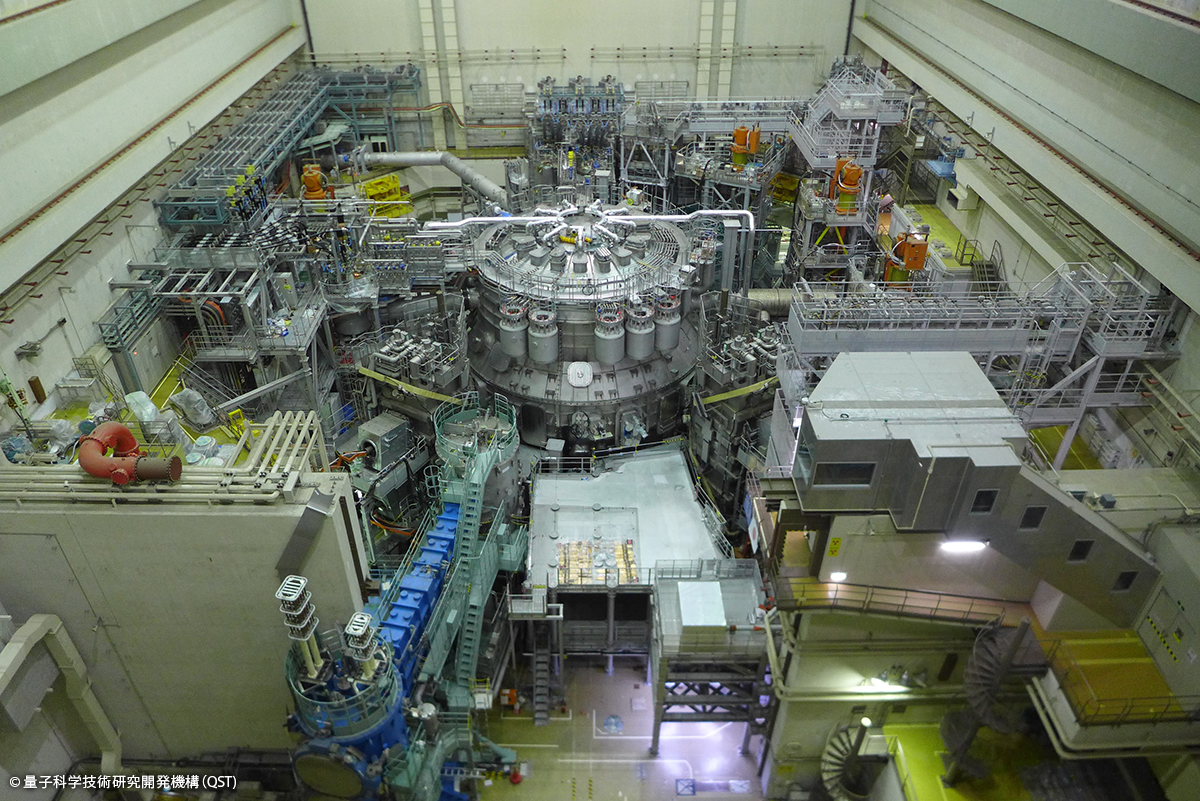
JT-60SA (located within the QST site in Naka City, Ibaraki Prefecture)
JT-60SA uses powerful superconducting coils cooled to approximately –269°C (about 4 K) to create a magnetic cage that confines plasma reaching temperatures of 100 million degrees Celsius.
The tokamak configuration is one method of magnetic confinement, combining superconducting coils to generate a toroidal magnetic field around the device and a poloidal magnetic field across its cross-section, producing twisted magnetic field lines along a donut-shaped path.
ITER is also a tokamak-type device.
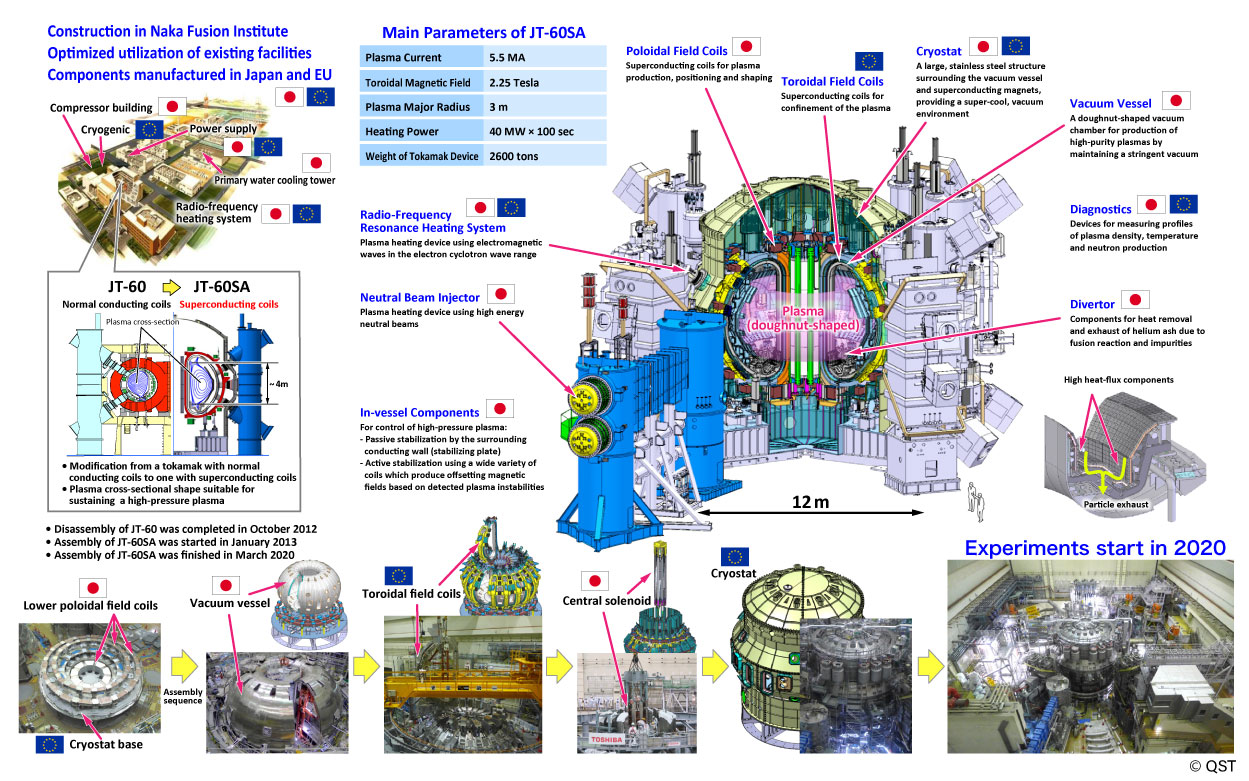
JT-60SA Device Overview Diagram(Source: QST | What Is the JT-60SA Project? )
References:
What is JT-60SA?
QST | What Is the JT-60SA Project?
Editor’s Note
Nuclear fusion—distinct from fission—represents a new pathway for generating energy by uniting matter rather than splitting it.
Our commitment to both decarbonization and a reliable power supply remains steadfast.
The serene yet resolute light I observed in Naka symbolized a future shaped by bold innovation and scientific dedication.
(Written by Taiyo Tenno)